Sunday, April 29, 2012

PICTURE THIS --- OUR FIRST NATIONAL TRACTION MEET

    
An Idea for a Universal Module for a T-to-the-Fourth Power National Show
                                                                                                                                                             This is a photo of a track arrangement called a Grand Junction (or sometimes  a "Grand Union"), not uncommon in street railways of the Reminiscence Age (1900-1950) .

Picture some skilled model trackworker in, for example, P Scale --- two inches to the foot, 9 1/2 inch gauge --- working assiduously at home to build that trackwork to pre-arranged, pre-determined track standards and clearances, and mounting that trackwork on a three-quarter-inch plywood base .

He then brings it with him in his pickup truck or small trailer***  to the Grand  Transit-Traction-Trolley-Tram Model Electric Railways Meet at the Magnificent Resort Hotel and Conference Center in Center City, Florida [You'll notice that I refuse to get specific at this time ! ] , sets it up on a sturdy chest-high table in their Grand Ballroom, and waits for the other pre-arranged modules to show up.

Each of them brings their connecting straight line of a street scene OR even a trolley barn, conforming to standards in the widely distributed 2"=1'   P Scale Module Standards Manual, connects one module at each compass point. Then everyone else excitedly places their Birney or Peter Witt on the tracks and our First Annual Grand etc. Meet gets off to a spectacular start.

Swarms of brand new garage-based entrepreneurs bring their scale accessories; building fronts; trackside details; 10- to 12- inch high miniature (action) figures, accurately dressed in their best NON-MILITARY 1937-era street clothes; some spectacular, highly detailed, large scale model automobiles, including the new Chrysler Airflow and the slick new Buick ("Ask the man who owns one") ; accurately uniformed street railway figures, such as motormen, conductors, track workers with tools; PLUS trolley and tram books, videos, recordings, and pictorial history books; and any other traction memorabilia limited only by their imagination and the size of their collections .

Trolley museums and model traction clubs desperately seeking new members will have set up information stands around the hall, staffed by bright, cheerful members, the very best representatives of their club . The Grand Junction would be placed in the very center of the huge Exhibition Hall to greet the awestruck public, press, and other visitors as they swarm around the exhibits . Smaller modules and display stands will show the very best of a wonderful hobby, models that most people had never witnessed in the original prototype size . Also present would be celebrities who have been keeping their shameful secret interest in traction and miniature modeling to themselves until now. Dozens of professional videographers as well as members of the hobby press and the Mainstream Media, including 60 Minutes and Fox News, would be running busily around interviewing hobbyists and politicians hoping to associate themselves with this wholesome, hometown, nostalgic vision of a previous, peaceful age. The thousands of miniature hobbyists, until now used to smaller scales, will stagger back in shock and admiration when seeing P Scale for the first time.

If you guys can pull that off, I promise to be there !! ... and will Blog about it for months ! 

*** If the best track builder is not the person with the biggest pickup truck, it may be possible to send the Grand Junction Module to Florida by a delivery service or trucking company.

Saturday, April 28, 2012

WHAT AN EXCELLENT APPROACH TO EDUCATION


Remember how boring the subject of history was when we were in school ?
... and the eternal (meaningless to many) tangle of x's, y's, and z's that many of us encountered in algebra ? There must be a better way to perform this necessary process called "Education" , one would think !

Just consider an independent school program focused on transportation in general, and on electric railways, in particular .

Start with automobiles (yes, we know that they are decidedly NOT electric railways) . We would be hard put to find a more interesting --- think 'obsessive' --- topic for many youngsters. That gets them through the basics of internal combustion engines, lots of basic science ...

Then : electric railways --- electricity, magnetism, radio (communication, control), safety, geometry, geography (why railroads are sited -- situated -- where they are) and on and on and relevant on ! economics, supply chain and transportation, basic bookkeeping and accounting, metal trades, construction, engineering, and programming languages

The basics of English or other appropriate native language(s) for those written reports that they'll be composing for the rest of their lives, foreign languages to get through those travel books and manuals about the French Metro or the Deutsche Bundesbahn .

General history up through the history of transportation history : starting with nostalgia, reminiscences, through the history of electric railways --- horse cars, electric street railways, trolleys, public transit ...

... and then through the history of rail technology, through monorails and even magnetic levitation --- that never seems to fail to elicit amazement . Remember that it was the magic of magnetism that first stimulated Albert Einstein to think about the basic forces of the physical universe.

In relatively little time, and with rapt attention, students would be exposed painlessly to a very wide spectrum of the basic foundations of a good education. Let's not leave education to the dry expository curricula of the theorists. We've got a wonderful world of history, right here in our favorite subject matter.

Thursday, April 19, 2012

PUTTING MY IDEAS AND MY REPUTATION (such as it is) ON THE LINE

Well, talk is cheap (and so is writing BLOGS) . It was relatively easy to make recommendations to our faithful readers (Press the "FAITH" button on your keyboard for information on which faith) based on a long life of ... well, life .

We have suggested pathways to success of T-to-the-Fourth-Power (Trolleys, Trams, Traction, and Transit) organizations, and we can (and have) sat back smugly waiting to hear your success stories. We're going to submit our suggestions to the ultimate test, putting them into action, and see just how they work for us.

This past week, I witnessed personally how a small hobby group at a 2,000-person community --- in a modest retirement area of Florida --- have grown, from scratch, a program of  events and amateur sales, using only volunteer assistance from a small total membership --- maybe 40 or 50 --- into a fund-raising sales event at which people started lining up early in the morning, hours before the announced opening, to browse and buy goods donated by residents of the community, and jammed the aisles until closing, carting away a very high percentage of the goods of mixed value and utility, to have a large group of volunteers carefully pack everything up, leaving behind a clean, empty activity hall as mute witness to a frenzy of buying that reminded us of nothing so much as the pre-Christmas retail panic buying of Black Friday.

We smiled to ourselves as we recalled comments made by some of our correspondents :
1. "Florida ? It's too warm !" (the outside temperature this January was 60 degrees Fahrenheit)  ,    
2. "We prefer holding our events in places that are easy to get to" , (like the gymnasiums of universities that require that maps be published to find)
3. "No one will come that distance", (this from a group that scheduled their event in Kuala Lumpur, Malaysia, and were surprised (we imagine !) when they had to cancel the program for lack of pre-attendance registration

Our visitors / buyers came from Michigan, Pennsylvania, Ontario, New Jersey, and on and on and on ...  Build it and they will come ! .. maybe not the first year, we were not present, or the second, but building on what they had, year after year.
We understand that many appear to have headed afterward to nice restaurants in the vicinity, based on their questions to us. Nice for the neighborhood, and the economy, too.

The other example dangled before our eyes this past week was a show and administrative meeting held  by a State organization of highly specialized collectors in a luxury beach-front resort in St. Pete Beach [official short name for  St. Petersburg Beach, Florida) where these collectors (in their 50's, 60's, and 70's) showed up a week early in reserved rooms and suites, where they held informal in-room trading and buying sessions before the official show itself, and then stayed for the four-day-long State Show, which was advertised in national periodicals and so-called  house organs.

We said to ourselves : If those people can do it, and if we can talk about it to you as our audience, why can't we try it --- on a small scale at first. Maybe hold a free Trolley Film Festival, if we can get a suitable venue; order some good traction videos from Jim Herron, up in the Greater Tampa Bay area, and try to launch a small club.

We envision using that club as a base :
  • working towards regular meetings; 
  • discussing construction of traction equipment in the larger unappreciated scales --- yes, larger than O and G scales
  • moving toward acquring a regular meeting place
  • attracting new, young people to the hobby
  • asking skilled old-timers to teach building skills to teenagers and youngsters, perhaps through Scout groups 
  • seeing if we could work with the school system, currently in under-funded disarray
  • Public Relations
  • Public Relations, and
  • Public Relations (our equivalent of the Real Estate : Location, Location, and Location)
... maybe even by following our own advice !

Sunday, April 15, 2012

Working Together to Achieve Growth and Purpose

I was encouraged by the readership and response to our Blog about getting together. The reason that we held up the model airplane field as a Role Model (pun NOT intended) is its effective use of the Academy of Model Aeronautics as a unifying principle.
That being said, there are negative aspects to an AMA-type (some politically-oriented modelers might say, a United Nations-type) of organization. People in our post-modern world are not happy about being told what to do. The American Tea Party movement, the Arab Spring revolts in the Islamic world, and so on are examples of a reaction to authoritarian structures that lead from the top down.
Nonetheless, it might pay to look briefly at  their accomplishments..
Basically, if you want to "play with model airplanes", as we are sometimes accused of "playing with model trains", you MUST join the AMA, and carry your little membership card about with you if you want to participate in a meet OR have some semblance of a voice in governance.
Non-card-carrying members of the public are welcome (even encouraged) to attend programs, but if you want to fly an airplane at an organized club meet, Join the AMA, period. The AMA then prescribes a series of --- essentially --- safety rules and uses its best efforts to encourage new members and organized, nationally-publicized programs. There are many other very good outcomes, but that's pretty much it.

National AMA events are well-publicized (when was the last national Trolley Meet?). There is a palpable sense of 'belonging' evident among members. A recent trip to the small local post office here in Florida, U.S.A., disclosed AMA decals proudly displayed on automobiles. Again, as mentioned in a previous blog, non-hobbyists on a casual visit to the local flying field were treated much as a welcome guest would be in your house.

I used to think that the insularity displayed by traction fans was the result of the many small streetcar lines that existed, a very local phenomenon so that a SEPTA fan was restricted in his own mind to a narrow mindset --- who cared about  California interurbans?

But, alas, it's more than that. A national group like the AMA can swing a lot of influence in publicizing events, in ensuring favorable stories about the hobby, and even in focusing on full-size history, photography, image treatment and archiving, about programs that bring new people - especially our yout'  -- and in many more areas of growth and exposure (the two go together) .

The insularity is even more evident when it comes to drawing distinctions between, say, North American streetcars and UK trams, OR between heritage trolleys and light rail vehicles. ... but most of all, if we want to encourage small garage-workshop manufacturing, in expanding the horizons of participants to someplace beyond their hometowns.

Basically, nature's Grand Program mandates "Grow OR Perish". As our ranks age in place, as we count the number of obituaries, we must realize the need to replace and increase our numbers. Unite or Dwindle might be a valid motto.

By the way, Giant Scale model airplane people, much like many live steam model railroaders, will hitch a trailer onto the family vehicle and load the very large components of their models into a trailer, then tow it to a regional or national meet. This comment is in response to the comments I received about a national program, when hobbyists asked whether we expected them to bring their trolley modules to a national program. Well, yes ! Can you imagine the media coverage? Speaking of which, how much use do we traction fans make of the Social Media. Frankly, I'm a complete novice there, but do as I say, not as I do, as I'm not a good role model there.

Anyway, you have my strong support for a national (or international --- do our people have any appreciation for the incredible light-rail networks that have spread across Europe, Asia, and ANZAC territory recently ?) organization that would unite instead of divide our ranks --- Unite or Dwindle !

Friday, April 13, 2012

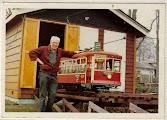
Gordon Hatch with a one-fourth size 15-inch gauge Birney


Gordon Hatch with a one-fourth size 15-inch gauge Birney :
The picture says it all


Sunday, October 30, 2011

Why Can't We All Just Work Together ?

This is a heartfelt plea to all the Electrically Powered Fixed Guideway interests --- trolley modelers and clubs; trolley museums; geographically-focused clubs like CERA; British trams; European transit groups; Light Rail associations etc. --- to set aside personal and local concerns, issues, and past differences . Understand that the hobby as a group can act together --- in unison --- and achieve their goals on many levels by cooperating in the formation of a national --- or even international --- group of enthusiasts (I love the British term as it addresses the necessary levels of focused emotion) .


If we could get the leadership of the various groups, special interests, clubs, and museums to truly lead :

a. Decide on a set of Missions and Goals that rise above track standards and a focus on local geography; b. Become a trend-setter instead of a collector of historical materials;
c. Lead their group to be more than an organizer of a once-a-year display;
d. Recognize that our public is beginning to consist of a smaller and smaller audience;
e. Put aside past grievances, imaginary or real;
f. Analyze the possibilities of this Special Interest of ours;

This can all be accomplished in the following straightforward way :

1. Organize nationally. This is now truly within reach through the use of the Internet, the Social Media, Remote Meeting methods, and other electronic means.

2. Inform the public through the Mainstream Media;

3. Utilize the powerful impact of viewing T-to-the-Fourth Power equipment in action

4. Through a carefully planned series of events that demonstrates What we Do and What we Love

5. Don't dwell on past differences ;

6. Don't keep doing the same thing over and over again, and expect different results --- Albert Einstein's definition of insanity;

7. Look back over previous Electric Railways Network Blogs;

8. Don't get bogged down by trivial past or imagined slights; and especially

9. Search beneath the (admittedly very modest) humor posted here, Get Together and Get the Word Out to throughout North and South America and the World by planning and running one or more major Conferences and Exhibitions in reasonable venues :

       A. NOT a college gym adjacent to a Bikers' Bar in an obscure town

       B. ... at times of comfortable environmental conditions and pleasant weather

       C. NOT Frostbite Falls, Minnesota OR Nunavut inside the Arctic Circle;

       D. NOT Florida during Hurricane Season, as one national model railroad show did

       E. NOT in distant, physically unreachable places --- Kuala Lumpur (no kidding, it was once
           suggested and even planned) OR the Amazon Rain Forest OR Siberia

       F. ... accompanied by an instructive, attractive broad-based exhibition, even encouraging commercial
           interests to participate

       G. ... with broad instructive talks, NOT with minutiae or trivial details

       H. ... as part of a major, well-planned campaign to demonstrate, teach, and sell the many fascinating
            aspects of our hobby.

10. Keep in mind that teaching T-to-the-Fourth-Power history is fascinating but NOT the Goal.

11. Remember that even in All-In-Combat, the antagonists shake hands before they "Come out fighting!" ... keep all your disagreements in a civil context, and confined to policy issues, not perceived personal ones

12. Recruit NOT just the trolley and transit magazines, but the national and international general- interest media The New York Times and its brethren; New Yorker magazine; TV channels --- History and family-oriented TV; Readers Digest; Reminisce Magazine; TIME magazine; children's media --- TV, Scouting magazines like Boys' Life; the model railroad magazines; EVEN transit advocacy groups and Transportation Planning organizations on the Local, County, State, and Federal levels (yup, you heard me correctly).

13. Hold it in a place where people will go with delight (e.g., Disney World, Orlando); places that are easy to get to, where people will want to bring their family, even --- NO, especially --- the ones not interested in T-to-the-Fourth-Power; provide a Guest Program for them, which automatically means a place with many family-oriented diversions (like Disney World, Orlando).

Use the power of technology to schedule Pre-Event planning meetings using remote video conferencing communication.

Save the Naysayers and Sour-Faces for your local meetings (How has that been working out for you?).

Make it easy for non-US groups to participate --- it may be painful for some to admit, but neither financial nor transportation issues necessarily revolve around the USA these days --- that means easy Bureau de Change currency exchange --- try that in your local college gym -- plan for multi-lingual translation (including Russia, China, the Near- and Middle-East)

See if --- as a Group, a nascent Organization --- you can persuade major interests in Transit to foot the bill for some of the expenses of the planning period.

We were appalled when, in planning for a respectable Conference, we tried to contact major transit equipment manufacturers. Most of them didn't even respond to our (literate) letters or our eMails, providing us with an example of How to Influence People in the worst possible way ! It only takes five minutes to decline an invitation politely by eMail these electronic days.

All in all, we've given you a large amount to chew on. If you're happy, please let us know. If it's Quixotic, we guess we agree with you, but that shouldn't stop anyone. If you're angry beyond reply or polite discourse, we're so sorry --- as one of our faculty colleagues used to say --- So sad, Too bad.

Just consider the consequences of doing nothing (AGAIN : How has that been working out for you?).

HNILS@MSN.COM                                               HYBRIDPELTA@HOTMAIL.COM

Thursday, October 13, 2011

A New Concept in T-to-the-Fourth-Power Museums

First, probably most of you are wondering what "T-to-the-Fourth-Power" means.

The several hundred good people who have been reading this Blog may already know :
It's an abbreviation for the four "T"s" :
     Trolleys
     Trams (essentially, European, Australian, and Asian trolleys, streetcars, and light rail)
     Traction (the old name for rail lines run by electricity), and
     Transit (the New York subways, the Chicago El, the London Tube, the Paris Metro, interurban electric railways, etc.)

Second, why a museum of this stuff? We already have trolley museums; the famous Tich tram museum in the U.K. (England) ; the many local trolley museums in the United States, and quite a few others. Do we really need more ?

... and why now ?

Questions with easy answers, once you think it through in a broad Time and Space perspective.

1. Our North American trolley museums are delightful , nostalgic collections of antique and vintage traction equipment. BUT, they need very large budgets which will undoubtedly increase with time and inflation, and large amounts of ever decreasingly-available space.

2. Equipment maintenance is a difficult labor-intensive task , requiring large expenditures these days

3. The ride provided to visitors is overshadowed --- in most visitors' minds --- by the kinds of "rides" available in theme parks and amusement parks

4. Volunteers --- for any optional activity --- are becoming less and less available because of economic times, an older labor force that needs to spend its time in more financially rewarding ways, the increasing dearth of knowledge about "streetcars", how they work, and the mission, ethic, and function of museums, [we know; we've been there].

5. Grant money, local government appropriations, and private donations are becoming rare.

6. Much information regarding traction, and appreciation for its role, is fading from the public consciousness.

What is the answer ? ... or rather, what is one solution?

Follow the course set by maritime museums, which have become satisfied with --- and flourish with --- model ships.

Arguably the largest percentage of trolley museums provide a passenger ride for a few miles on hard-to-maintain track laid on hard-to-come-by land. It occurred to some of us that with many of the huge "Big-Box" stores, very large restaurants, and Supermarkets going belly-up in this economy, leaving enormous empty spaces that, in our own experience lie vacant for --- in many cases --- years, could be turned to good and interesting use.

Dictum one : Don't Ride 'em, watch 'em

If we take into consideration the tremendous impact size has, and can convert our model thinking into mega-model size --- anywhere from "Live Steam" scale (one-eighth size) up through GH size for the late Gordon Hatch of Victoria, British Columbia, Canada (one-fourth size) models --- that can run indoors because they are safely powered by electricity, like any model transit equipment --- you realize that, with one stroke, costs of acquisition, construction, and maintenance have been reduced to manageable proportions.

Dictum Two : Size Matters

Suddenly, these museums become readily manageable, on every count.

1. Youngsters, eager for new experiences and without the funds or physical strength of adults, can become candidates for both membership and internship as working members;
2. retired adults: an enormous untapped resource. One retirement community --- not a nursing home, not a managed care facility --- alone can have over 2,000 residents who can participate or commit to volunteer; an operating budget no longer matches that of the Pentagon ; retired workers often carry with them into retirement the very skills and work ethic required;
3. the scope of both display and operation is within everyone's capability.
4. Location of, and access to, many of these vacant properties : much more convenient, translating into many more visitors and easier access by volunteers and staff.
5. Cost of exhibits drops dramatically.
6. Non-availability of replacement parts is much less of an issue.
7. A modest machine shop can serve dual purposes : it can be used to site-manufacture metal and wood parts for use in the museum OR offered for sale to new hobbyists, and it can be used as a basis for training youngsters in the use of serious machine tools under adult supervision.
8. Some of these museums might become adjunct facilities of school systems that are strapped for money and that (coincidentally) are not building a knowledgeable labor base for the future of manufacturing in America (North and South). Working with the Society for Industrial Archaeology or other such major non-profits as engineering schools could also be considered.
9. We just read a survey which indicated that a large majority of our youth don't even know which way to (ready for this one?)  turn a screwdriver ! There's a selling point for a private education initiative !
10. Our education systems (full disclosure : of which we ourselves have been members for many years) often appear to lag many years behind our country's needs, and generally provide inadequate career guidance to both students and workers alike.

It doesn't take much to start a traction museum, one that would match the best of the maritime museums, other than the good sense and the will.

If the project seems beyond the means of a group, just compare it to running a conference or exhibition each year, with attendant set-up, breakdown, advertising, and persuading members to pitch in. Here, once set up, the basics remain. Comparing it to an operating trolley museum leaves the operating approach far behind in many ways.

More requirements and ideas will follow !